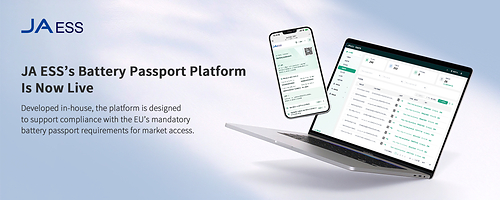
JA ESS, the energy storage business unit of the JA brand, has introduced a battery passport platform built by its own team. The announcement was issued from Beijing on 20 November 2026. The system runs in the company's own cloud environment and is intended to manage battery lifecycle information and help customers prepare for EU obligations.
Under the EU Batteries Regulation, passports become mandatory on 18 February 2027 for three groups placed on the EU market or put into service: electric vehicle batteries, batteries for light means of transport, and industrial batteries above 2 kWh. Further requirements will follow. Each passport is a digital record tied to a single physical battery through a QR code and a unique identifier built on the ISO/IEC 15459 series. It can include composition, carbon footprint, recycled content, performance, durability, state of health, supply chain due diligence and end-of-life treatment.
JA ESS says compliance involves more than generating a QR code. Data has to be traceable to its origin, kept up to date and made available in line with regulatory and commercial needs. Companies must also control sensitive information and respect trade secret and cross-border data transfer rules. The company notes that when a third-party platform is used, its features, field access and interoperability can depend on how the provider configures its service.
The company's own staff manage the platform's data policies, access permissions and updates. JA ESS says the system will be adapted as regulation and practical experience develop. The unit supplies storage for utility-scale, commercial and industrial, and residential markets.
Why it matters for DPP projects
With battery passports due from 18 February 2027 for EV, LMT and larger industrial batteries, manufacturers need to decide soon whether to build in-house or use an external platform. Teams comparing options can ask providers who controls data policies and access rights, how trade secrets and cross-border transfers are handled, and how the system will be updated as requirements change.
ORIGINAL SOURCE
Batteries News
Reported 21 November 2026
This summary was written automatically from the source and checked against it before publishing. It is not legal advice; confirm details in the original before acting on them. Report an error